Electronic components list with functions, ratings, and selection notes
Quick electronic components list
A practical electronic components list groups parts by what they do in a circuit: controlling current, storing energy, switching signals, processing data, protecting the board, or connecting one assembly to another. The core list includes resistors, capacitors, inductors, diodes, transistors, integrated circuits, sensors, connectors, switches, relays, fuses, crystals, and power modules. For PCB work, the list also needs enough detail to support design, assembly, and purchasing decisions, including the reference designator, main electrical ratings, package style, polarity, tolerance, operating temperature, lifecycle, and compliance status.
For more background on component families and electronics terminology, see the Components section.
| Component group | Common examples | Main circuit role |
|---|---|---|
| Passive components | Resistors, capacitors, inductors, ferrite beads, transformers | Limit current, store energy, filter signals, shape impedance |
| Active semiconductors | Diodes, transistors, MOSFETs, IGBTs, integrated circuits | Switch, amplify, rectify, regulate, compute, communicate |
| Timing and frequency parts | Crystals, oscillators, resonators, clock generators | Provide stable timing or frequency references |
| Protection components | Fuses, resettable fuses, TVS diodes, MOVs, gas discharge tubes | Reduce damage from overcurrent, surge, ESD, or transient voltage |
| Interconnect parts | Headers, terminals, board-to-board connectors, cable assemblies | Create removable or permanent electrical connections |
| Electromechanical parts | Switches, relays, motors, fans, buzzers, solenoids | Convert electrical action to mechanical action or user input |
| Power components | Regulators, converters, power modules, batteries, current sensors | Generate, convert, monitor, or distribute power |
Passive components
Passive components are generally described as parts that do not provide gain. They are still central to circuit performance because they set voltage levels, current paths, noise behavior, timing constants, and thermal stress. In practice, the passive-active boundary can depend on context, especially for batteries, sensors, and protection parts. For a PCB bill of materials, the more useful questions are what the part does, which ratings matter, and which conditions could make it fail.
Resistors
Resistors control current, divide voltage, set bias points, terminate signal lines, discharge capacitors, and convert current into measurable voltage. Fixed chip resistors are common on modern PCBs. Variable resistors, trimmers, and potentiometers are used where adjustment is required. Key ratings include resistance value, tolerance, power rating, maximum working voltage, temperature coefficient, package size, and noise behavior. A 10 kΩ resistor in a sensor divider and a 10 kΩ resistor in a high-voltage circuit may share the same nominal value but carry very different safety and accuracy requirements.
Capacitors
Capacitors store charge in an electric field. They are used for decoupling, filtering, AC coupling, timing, energy hold-up, snubbing, and EMI control. Ceramic capacitors are widely used for local decoupling near IC power pins. Aluminum electrolytic, polymer, tantalum, and film capacitors are often selected for bulk storage, ripple current, low loss, or stability. The main specifications are capacitance, voltage rating, dielectric material, tolerance, equivalent series resistance, ripple current, leakage current, temperature range, lifetime, and polarity. Designers should also consider voltage derating because some capacitor types, especially multilayer ceramic capacitors, can lose effective capacitance under DC bias.
Inductors, transformers, and ferrites
Inductors store energy in a magnetic field and resist changes in current. They are used in switching regulators, filters, RF matching networks, and noise suppression. Transformers transfer energy between windings and provide voltage conversion or isolation. Ferrite beads are often used to attenuate high-frequency noise, but they are not universal fixes; the impedance curve, current rating, and heat rise must fit the circuit. Selection usually involves inductance, saturation current, RMS current, DC resistance, self-resonant frequency, shielding, size, and core material.
Crystals, resonators, and filters
Timing parts such as quartz crystals, ceramic resonators, and oscillators define the frequency reference for microcontrollers, radios, communication buses, and real-time clocks. Filters may be built from discrete RLC networks or purchased as integrated EMI, RF, or power-line filter components. These parts should be checked for frequency tolerance, load capacitance, aging, drive level, insertion loss, bandwidth, impedance, and the layout guidance in the datasheet.
Active semiconductor components
Industry market datasets often classify semiconductors as logic, memory, analog, discrete, optoelectronics, sensors, and actuators. That classification helps separate simple two- or three-terminal devices from highly integrated chips. On a PCB, the practical decision is more specific: what function the semiconductor performs, and how sensitive it is to voltage, temperature, ESD, firmware, and layout.
Diodes
Diodes conduct more easily in one direction than the other. Rectifier diodes convert AC to DC or steer current. Schottky diodes are used where low forward voltage and fast switching are important. Zener diodes and TVS diodes clamp voltage, although surge rating and response behavior vary by device type. LEDs emit light and are selected by color, luminous intensity, forward current, viewing angle, and thermal path. Common diode specifications include reverse voltage, forward current, forward voltage, recovery time, capacitance, power dissipation, and package.
Transistors and power switches
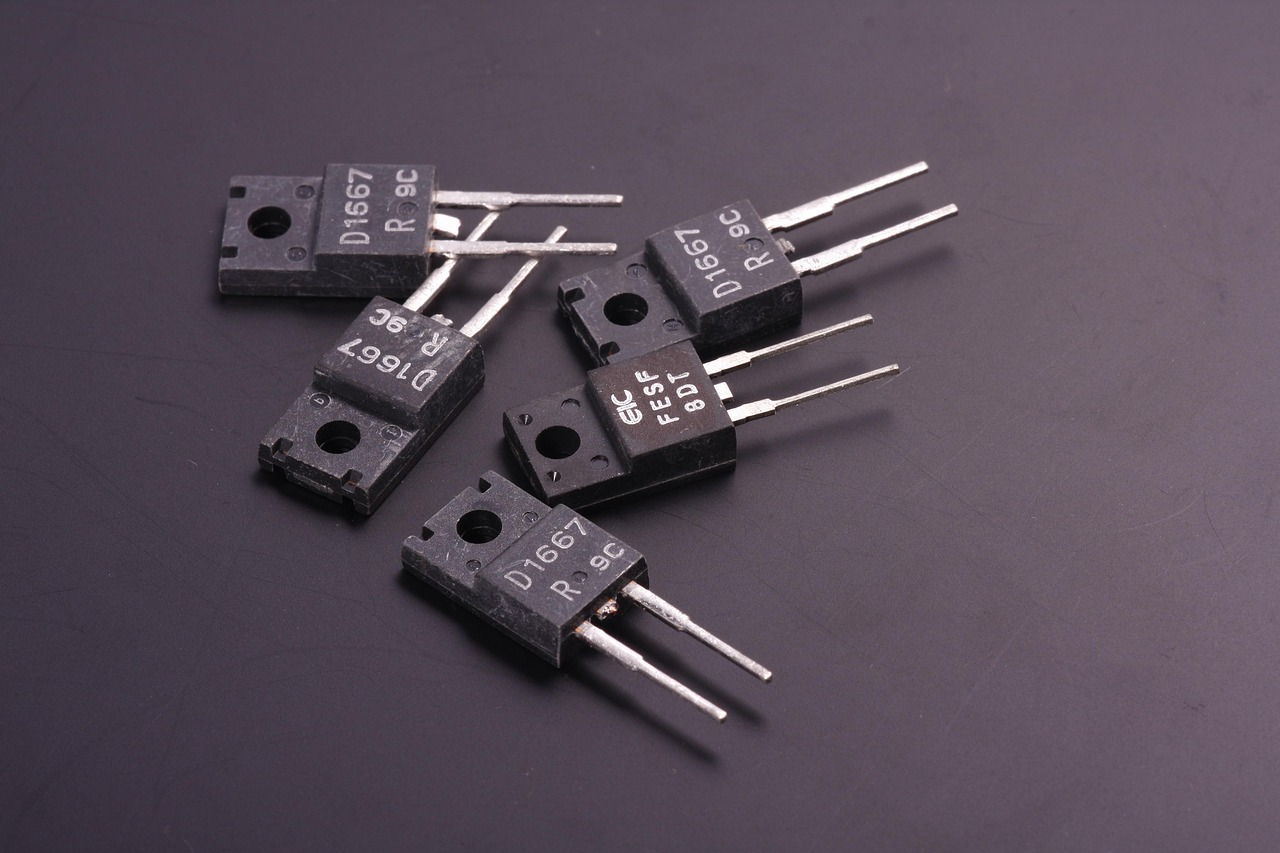
Transistors amplify or switch signals. Bipolar junction transistors remain useful for low-cost switching, current mirrors, and analog stages. MOSFETs dominate many power switching applications because of their gate-driven control and low on-resistance options. IGBTs are used in some higher-voltage and higher-power systems. When selecting a transistor, look beyond headline voltage and current. Gate charge, safe operating area, thermal resistance, switching loss, leakage, package inductance, and drive requirements can determine whether a part survives in the actual circuit.
Integrated circuits
Integrated circuits combine many circuit elements in one package. They include microcontrollers, processors, memories, logic gates, amplifiers, comparators, ADCs, DACs, voltage regulators, battery chargers, motor drivers, interface ICs, RF transceivers, and application-specific ICs. IC selection should consider supply voltage, I/O levels, interface standards, timing, firmware support, package availability, thermal limits, moisture sensitivity, and long-term supply status. For complex ICs, the reference design and layout notes are often as important as the electrical table in the datasheet.
Sensors and optoelectronic components
Sensors convert physical conditions into electrical signals. Examples include temperature sensors, pressure sensors, accelerometers, Hall-effect sensors, current sensors, image sensors, and optical detectors. Some are simple resistive or passive elements, while many include signal conditioning and digital interfaces. Optoelectronic components include LEDs, photodiodes, phototransistors, optocouplers, laser diodes, and displays. Selection depends on range, accuracy, calibration, response time, interface, noise immunity, package exposure, and environmental protection.
Interconnect, electromechanical, and protection parts
Connectors, switches, relays, cables, terminals, sockets, and wire harnesses are sometimes treated as secondary items, but they are common sources of field problems. A connector must match current rating, voltage rating, pitch, mating cycle life, contact plating, locking method, cable strain relief, and operating environment. A switch must match current, contact material, actuator life, tactile feel, sealing, and bounce characteristics. Relays add coil voltage, contact rating, isolation, operate time, release time, and mechanical life to the selection list.
Protection components should be selected according to the expected fault, not by a generic part name. A fuse responds to overcurrent and must coordinate with the power source and downstream traces. A resettable fuse can be useful in low-power applications, but its hold current changes with temperature. A TVS diode clamps transient voltage and needs the right working voltage, clamping voltage, peak pulse power, capacitance, and placement. MOVs and gas discharge tubes are used in higher-energy surge environments, especially where safety and regulatory testing define the design target. See also: Gadgets.
How components appear in schematics, PCBs, and BOMs
The same component may be described in three ways: by its schematic role, by its physical package, and by its purchasing identity. A schematic might call a part C12, the PCB layout may place it as a 0603 footprint, and the bill of materials may specify a manufacturer part number with a 10 µF nominal value. Keeping these views consistent is essential for assembly and troubleshooting.
| Reference designator | Typical component | Notes |
|---|---|---|
| R | Resistor | May include shunts, thermistors, or resistor arrays depending on company convention |
| C | Capacitor | Polarity should be clear for electrolytic and tantalum types |
| L | Inductor | Ferrite beads may use L, FB, or a local convention |
| D | Diode | Often used for rectifiers, Zeners, TVS diodes, and LEDs |
| Q | Transistor | Common for BJTs, MOSFETs, and other discrete transistors |
| U or IC | Integrated circuit | Pin-one marking, footprint, and orientation must be verified |
| Y or X | Crystal or oscillator | Load capacitance and placement affect performance |
| J or P | Connector | Pin numbering and mating part should be documented |
| SW, K, F, TP | Switch, relay, fuse, test point | Conventions vary between organizations and CAD libraries |
Reference designators help identify a board, but they are not enough on their own. Board markings may be abbreviated, supplier logos can be hard to read, and identical packages can contain very different devices. Reliable identification normally requires the schematic, BOM, package marking, datasheet, and surrounding circuit context.
Selection checklist for design and sourcing
A component list becomes useful when it reduces design risk and purchasing ambiguity. For each non-trivial part, capture the function, electrical ratings, tolerance, package, manufacturer part number, approved alternatives, compliance status, and lifecycle stage. In production, add quantity, reference designators, placement side, assembly notes, moisture sensitivity where relevant, and any programming or calibration requirement.
- Electrical fit: Check voltage, current, power, frequency, accuracy, timing, and signal-level compatibility under worst-case conditions.
- Thermal margin: Estimate power dissipation and temperature rise, not just ambient rating.
- Package and land pattern: Confirm footprint, pinout, height, polarity, solderability, and assembly process compatibility.
- Availability: Review lead time, lifecycle status, minimum order quantity, packaging format, and second-source options.
- Documentation: Use manufacturer datasheets and controlled BOM revisions rather than informal part descriptions.
- Manufacturing standards: PCB teams commonly refer to IPC design, land-pattern, soldering, and acceptability standards when defining build requirements.
The cheapest part is not always the lowest-cost choice. A resistor with poor tolerance can increase calibration time. A connector without a positive lock can raise return rates. A regulator in the wrong package can force a larger PCB or a heat sink. Treat component selection as a system decision, not just a catalog search.
Compliance and reliability considerations
Electronic components may carry environmental and regulatory obligations depending on where the final equipment is sold. In the European Union, RoHS Directive 2011/65/EU entered into force on 21 July 2011 and restricts the use of certain hazardous substances in electrical and electronic equipment. The restricted list includes lead, cadmium, mercury, hexavalent chromium, PBB, PBDE, DEHP, BBP, DBP, and DIBP, subject to scope details and exemptions. REACH obligations may also apply to articles containing substances of very high concern above defined thresholds. These rules are product- and market-specific, so manufacturers should verify current legal requirements rather than relying only on a distributor filter.
Reliability also depends on sourcing discipline. Authorized distribution, manufacturer traceability, date-code control, moisture-sensitive handling, ESD-safe packaging, and counterfeit-risk procedures matter most in medical, automotive, aerospace, industrial, and safety-related equipment. Even in less regulated products, a clear approved vendor list and alternate part strategy can prevent redesigns when a component becomes obsolete or unavailable.
Frequently asked questions
What are the most basic electronic components?
The most basic components are usually resistors, capacitors, inductors, diodes, and transistors. Integrated circuits, connectors, switches, LEDs, sensors, and voltage regulators are also common in modern beginner and professional circuits.
Is an integrated circuit one component or many components?
In a BOM, an integrated circuit is normally listed as one component. Electrically, it may contain thousands, millions, or billions of internal devices. This is why IC datasheets, pinouts, layout guidance, and firmware requirements must be treated as part of the component decision.
Are connectors considered electronic components?
Yes. Connectors are commonly included in electronic component catalogs and PCB BOMs, although they are electromechanical rather than semiconductor devices. They are essential because they define how power, signals, and mechanical interfaces enter or leave an assembly.
What should be included in a component BOM?
A practical BOM should include reference designators, quantity, value, description, package, manufacturer part number, approved alternates, supplier information, tolerance or rating details, lifecycle status, and compliance notes. Assembly-specific fields such as polarity, placement side, and special handling can prevent costly build errors.
How can you identify unknown components on a circuit board?
Start with the reference designator, package shape, polarity mark, and printed code, then compare the surrounding circuit with the schematic if available. Do not rely on size alone, because many unrelated parts share the same package. For critical repairs, confirm the part with the BOM or manufacturer documentation.