What Are Capacitor Components and How Do You Choose the Right Ones?
What Are Capacitor Components and Why Do They Matter?
Capacitor components are used in almost every electronic product, from a phone charger to an industrial motor drive. If you buy, design, or repair boards, it helps to know how capacitors behave in real circuits. That knowledge can prevent noise issues, unstable regulators, hot parts, and rework that should have been avoided. For more component basics, you can also browse the Components section.
Public industry data also shows why this small part needs careful attention. TrendForce reported in November 2023 that global MLCC demand was expected to rise about 3% in 2024 to roughly 4.331 trillion pieces. This number is not a design rule, but it gives useful market context. Capacitor buying is a high-volume, low-margin job, and one wrong specification can become a production problem very quickly. (trendforce.com)
Stored Charge for Fast Circuit Support
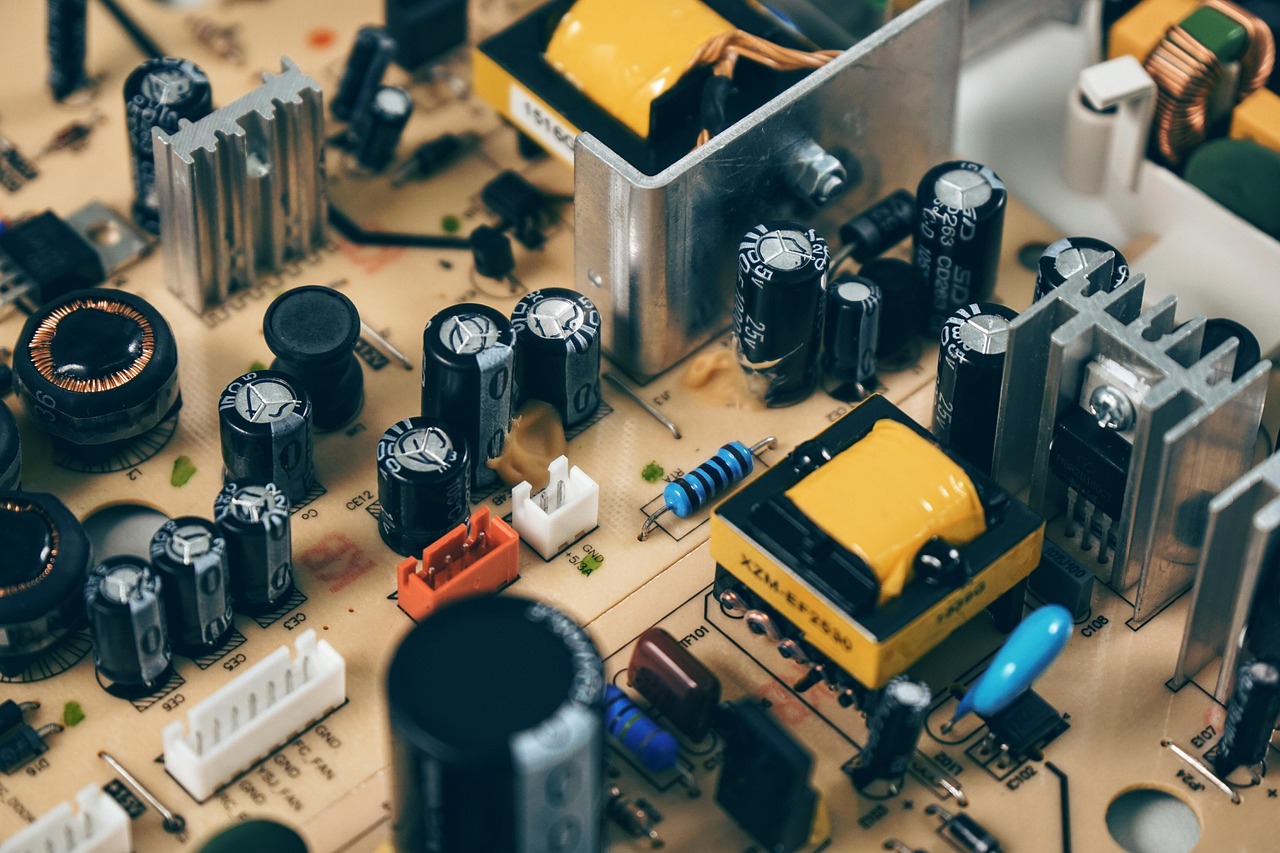
A capacitor stores electric charge between two conductive plates with a dielectric between them. On a real PCB, that stored charge can give an IC a short current reserve when it switches. It can also smooth a rectified supply, pass AC in a coupling path, or set timing together with a resistor. A 100 nF ceramic capacitor beside a microcontroller power pin may not look important, but if you remove it, the board may reset when a relay clicks.
Dielectric Material Defines Real Behavior
The dielectric decides much more than the nominal capacitance value. C0G or NP0 ceramic parts are stable, but they usually come in lower capacitance values. X5R and X7R ceramic parts can fit more capacitance into a small case, but their capacitance may drop under DC bias. Aluminum electrolytic capacitors are often used for bulk energy at a practical cost, while Film capacitors are common for pulse and AC work. A capacitor should never be judged only by its microfarad value.
Package Style Shapes Assembly Choices
Package style affects cost, PCB space, soldering, inspection, and reliability. An 0402 MLCC saves board area, but it is harder to inspect and may crack if the PCB bends during handling or use. A radial electrolytic may work well for repair and low-volume assembly, while an SMD polymer part fits automated production better. Before choosing a package, check the assembly line, expected vibration, board thickness, and inspection method.
Which Capacitor Type Fits Your Application?
No single capacitor type is best for every circuit. A sensible choice starts with the job of the capacitor, then the working environment, and then the supply chain. This sounds basic, but many poor builds start when someone copies a capacitance value from an old BOM and forgets to check dielectric, ESR, case size, or rated lifetime.
Ceramic Capacitors for Fast Decoupling
MLCCs are widely used for decoupling because they are small, cost-effective in volume, and useful at high frequency. Murata notes that MLCCs can have very low ESR and impedance, which is why they are often placed close to IC power pins. The point to watch is DC bias. A 10 microfarad X5R capacitor in a very small case may provide far less effective capacitance at working voltage, so check the manufacturer curve instead of relying only on the catalog line. (article.murata.com)
Electrolytic and Polymer Capacitors for Bulk Energy
Aluminum electrolytic capacitors are useful when a circuit needs high capacitance for input bulk storage, hold-up time, or low-frequency ripple smoothing. Polymer capacitors often offer lower ESR and better ripple performance than wet electrolytics, but they usually cost more. In a 24 V industrial control board, it is normal to place a larger electrolytic near the input connector and small ceramics near each IC. That mix is a practical design choice, not a messy one.
Film Capacitors for AC and Pulse Loads
Film capacitors are often used in snubbers, resonant circuits, EMI filters, motor drives, and pulse circuits. Metallized polypropylene film parts are commonly selected when stable loss behavior and AC stress matter. IEC 60384 includes sectional standards for fixed capacitors used in electronic equipment, including ceramic and film families. This is a useful reminder that capacitor type is linked to application class and test method, not only to capacitance value. (webstore.iec.ch)
Which Specs Should You Check Before Buying?
The value printed on the label is only the first item to check. A useful purchasing review should cover electrical behavior, temperature limits, mechanical fit, approvals, and lifecycle risk. When the team is under cost pressure, this kind of checklist stops people from saving one cent on a part and losing days on debug. Most buyers and engineers have seen that happen at least once.
Capacitance After Bias and Temperature
For ceramic capacitors, check how much capacitance remains at the real DC voltage and temperature. The nominal value is measured under set conditions, and your board may not work under those same conditions. For example, an X7R part used on a 5 V rail may look fine in a bill of materials, but the effective capacitance can fall after bias is applied. A safer habit is to compare capacitance curves from two approved suppliers before releasing the BOM.
Voltage Rating with Practical Derating
Voltage rating should not be treated as the normal operating point. High-reliability teams usually add margin because voltage stress affects service life. NASA EEE-INST-002, used for NASA Goddard space flight projects, lists capacitor derating requirements such as a 0.60 voltage derating factor for ceramic capacitors and plastic film capacitors, and 0.50 for solid tantalum capacitors at 70 °C. This is not a rule for every consumer product, but it shows how serious projects handle voltage stress. (nepp.nasa.gov)
ESR, ESL, and Ripple Current
ESR turns ripple current into heat, so it matters in any circuit that carries steady ripple. ESL limits high-frequency behavior, and ripple current rating is especially important in power supplies, motor drives, and LED drivers. Texas Instruments application material on LDO stability states that output capacitor ESR can affect loop stability, especially for older PNP or PMOS LDOs. If a regulator datasheet requires a certain ESR range, do not replace a tantalum capacitor with an ultra-low-ESR ceramic part before checking stability. (edgeworker.ti.com)
How Do Capacitor Components Affect Reliability?
Capacitor reliability depends on heat, voltage, ripple, mechanical stress, and handling. A part can pass incoming inspection and still fail early if it is placed beside a hot transformer, across a board flex area, or in a circuit with high plug-in surge current. Good capacitor design is not only electrical calculation. It also comes from layout habits that make sense on a factory floor.
Heat Drives Aging and Drift
Electrolytic capacitor life is closely linked to operating temperature because electrolyte dries out over time. A high-temperature rating gives more margin, but it does not remove the effect of a nearby heat source. Keep bulk capacitors away from hot heat sinks when the layout allows it. If airflow moves from a power resistor toward an electrolytic, that capacitor can become the quiet weak point in the product. See also: Gadgets.
Moisture and Reflow Need Clear Handling
Surface-mount parts must deal with moisture and reflow stress during assembly. Murata states that standard chip MLCCs evaluated by the company are MSL 1, while certain resin-molded surface-applied ceramic capacitor series are MSL 3. The practical lesson is simple: do not assume the handling rule only from the word ceramic. Read the packing label, bake rules, floor life, and reflow profile for the exact series. (murata.com)
Vendor Data Beats Generic Rules
General rules are useful during early selection, but the final choice should come from the maker datasheet, impedance curve, DC bias curve, ripple table, and soldering guidance. Two 22 microfarad X7R capacitors from different makers may behave differently in a buck converter. For long production runs, keep the PDF revision used during approval. Six months later, that small record may settle a supplier dispute much faster than email memory.
How Should You Source Capacitor Components for Production?
Sourcing capacitor components is not only a price job. Availability, authorized channels, traceability, package markings, and second-source fit can decide whether a product ships on time. In export trade, the end customer may never see the capacitor. They will still notice a noisy product, a short service life, or a shipment delayed by one missing 0805 part.
Approved Manufacturers and Traceable Lots
Use approved manufacturers and authorized distributors when the product has safety, industrial, automotive, or medical exposure. TDK reported capacitor sales of 234,260 million yen for FY March 2025, down 4.4% year over year, while passive components remained a major product group. The useful point here is not stock picking. It is that capacitors are a large global supply category, and vendor continuity matters for production planning. (tdk.com)
Safer Substitution During Shortages
During shortages, substitutions should compare capacitance, voltage, dielectric, tolerance, ESR, ripple current, temperature rating, package size, height, termination, and lifecycle status. For ceramics, also compare DC bias curves because the same nominal value may not give the same working capacitance. For electrolytics, compare lifetime and ripple tables at the same temperature. If one important parameter is missing, keep the substitute unapproved until engineering checks it.
Incoming Checks Before Assembly
Incoming checks do not need to be complex for every order. Start with label match, date code, moisture bag condition, quantity, visual damage, and sample capacitance where it makes sense. For higher-value builds, add ESR checks, X-ray for hidden terminations, or supplier certificates. A simple photo record of reel labels can save a lot of time when a field issue appears months later.
FAQ
Q1: What Are Capacitor Components Used For? A: They store charge, smooth voltage, filter noise, couple signals, block DC, shape timing, and support fast current demand near ICs.
Q2: Which Capacitor Type Is Best for Decoupling? A: MLCCs are usually used for high-frequency decoupling near chips, but DC bias, package size, and effective capacitance still need to be checked.
Q3: Can You Replace an Electrolytic Capacitor with a Ceramic Capacitor? A: Sometimes, but not without review. ESR, capacitance under bias, regulator stability, ripple current, and voltage rating must match the circuit need.
Q4: Why Do Capacitors Fail in Power Supplies? A: Common causes include heat, ripple current, voltage stress, poor soldering, mechanical strain, aging, surge current, and wrong part selection.
Q5: What Should You Check First When Buying Capacitor Components? A: Check capacitance, voltage rating, dielectric or technology, ESR, ripple current, temperature rating, package size, supplier status, and datasheet curves.