Electric circuit components and their roles in practical electronics
What electric circuit components do
Electric circuit components are the physical parts that make an electrical path perform a useful function. In practice, a circuit needs a source of electrical energy, conductive paths, a load that uses the energy, and some form of control or protection. Resistors, capacitors, inductors, diodes, transistors, switches, fuses, connectors, sensors, and integrated circuits each affect voltage, current, timing, direction, signal level, safety, or logic in a specific way.
Understanding these roles is more useful than memorizing a parts list. Most circuits are built by combining a small number of repeated functions. The sections below group the main component types by what they do, how they interact, and what engineers, technicians, students, and buyers should check before choosing parts. For more related articles in this topic area, visit the Components section.
The basic building blocks of a circuit
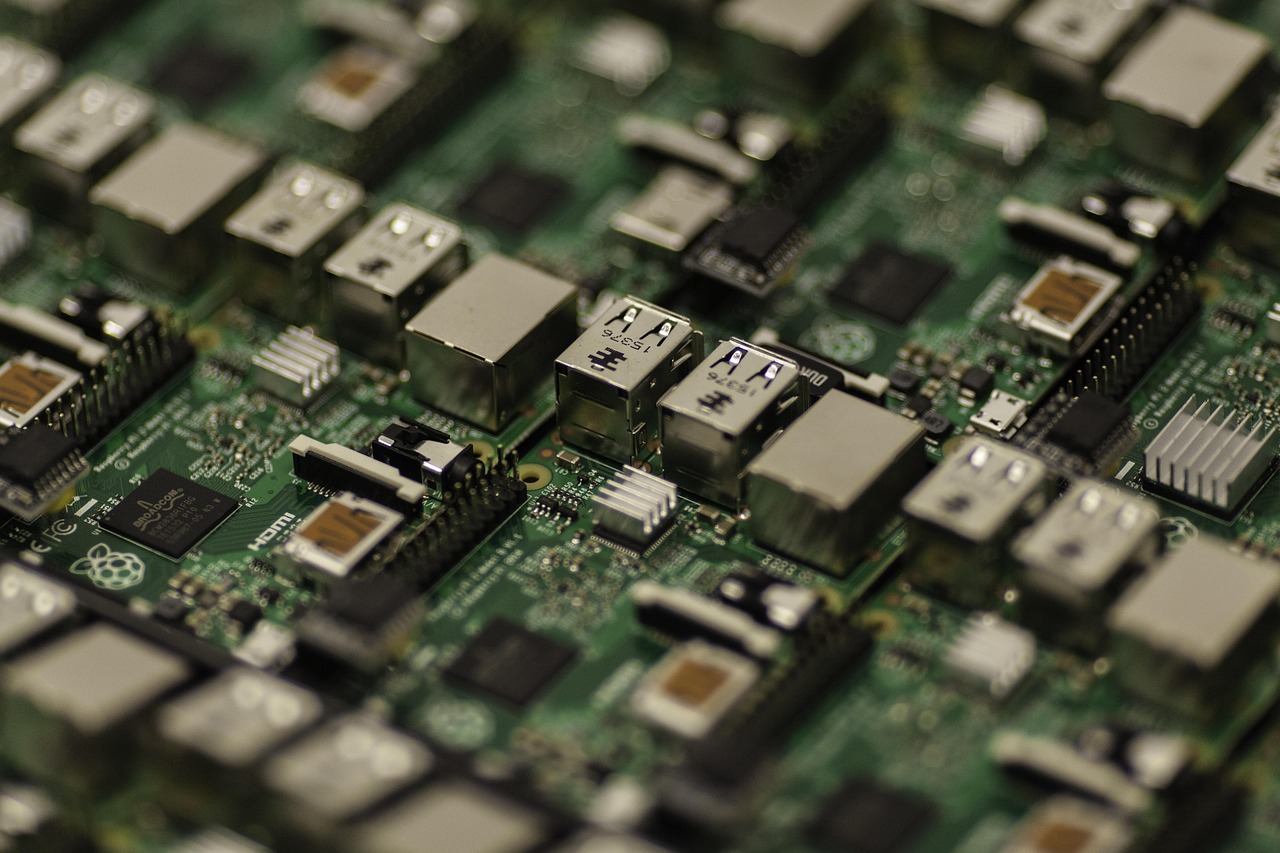
A circuit is not just a collection of parts. It is a closed path where electrical energy is supplied, directed, controlled, converted, stored, or protected. If a required path is open, current cannot flow through that branch. If an unintended low-resistance path appears, excessive current may flow and damage components.
Most circuits can be understood through five building blocks:
- Power source: A battery, power adapter, generator, solar cell, or regulated supply provides the voltage that drives current.
- Conductive path: Wires, printed circuit board traces, terminals, and connectors provide the route for current.
- Load: A lamp, motor, heater, loudspeaker, relay coil, sensor input, or electronic module uses electrical energy to do work or process a signal.
- Control element: Switches, relays, transistors, microcontrollers, and logic ICs decide when and how current flows.
- Protection element: Fuses, circuit breakers, resettable polymer devices, surge suppressors, and protective diodes help limit damage when abnormal conditions occur.
These building blocks appear in both simple and advanced designs. A flashlight contains a battery, conductors, a switch, and an LED or bulb as the load. A power supply contains more parts, but the same principle still applies: energy enters the circuit, is converted or regulated, and is delivered safely to a load.
Passive components that shape voltage, current, and signals
Passive components do not provide power gain. They can dissipate, store, filter, divide, or transfer energy, but they do not amplify a signal by themselves. The most common passive electric circuit components are resistors, capacitors, and inductors.
Resistors
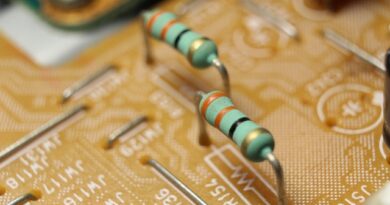
A resistor limits current, divides voltage, sets bias conditions, discharges stored charge, or converts electrical energy into heat. Its value is measured in ohms. In a simple LED indicator, the resistor prevents too much current from flowing through the LED. Using Ohm’s law, a 5 V supply and a desired 20 mA current would require about 250 ohms if the LED voltage drop were ignored. In a real design, the LED forward voltage, resistor tolerance, and power rating must also be considered.
Power rating matters because a resistor can overheat if it dissipates more heat than it is designed to handle. For example, a resistor carrying 0.25 A with 12 V across it dissipates 3 W, so a small quarter-watt resistor would be unsuitable. Designers normally choose a resistor with a power rating above the expected dissipation and also consider ambient temperature, enclosure airflow, and mounting conditions.
Capacitors
A capacitor stores energy in an electric field. In circuits, capacitors are used for smoothing power rails, coupling AC signals, blocking DC, timing, filtering, and reducing noise. Large electrolytic capacitors are common in power supplies, while ceramic capacitors are often placed close to integrated circuits to provide local decoupling.
Important capacitor specifications include capacitance, voltage rating, tolerance, equivalent series resistance, leakage current, temperature behavior, polarity, and package type. Polarity is especially important for electrolytic and tantalum capacitors, because reverse voltage can cause failure. Ceramic capacitors are usually non-polarized, but their effective capacitance can fall under DC bias, which matters in compact power and signal circuits.
Inductors
An inductor stores energy in a magnetic field and resists changes in current. Inductors are common in switching power supplies, filters, radio-frequency circuits, and energy conversion stages. In a buck converter, for instance, the inductor helps smooth pulsed current into a steadier output current.
Inductor selection is not based only on inductance. Current rating, saturation current, DC resistance, core material, frequency range, size, shielding, and thermal behavior can strongly affect performance. An inductor that saturates at the operating current loses much of its intended behavior and may cause overheating, noise, or poor regulation.
Active components that control and amplify
Active components can control current flow, switch signals, amplify, regulate voltage, or execute logic. They usually need a power source or bias condition to operate. Diodes, transistors, voltage regulators, operational amplifiers, sensors, and integrated circuits fall into this group.
Diodes
A diode conducts mainly in one direction. This makes it useful for rectification, reverse-polarity protection, flyback protection across relay coils, signal clamping, and voltage reference functions. Light-emitting diodes convert electrical energy into light, while Zener and transient-voltage-suppression diodes are commonly used in voltage limiting applications.
Key diode ratings include forward current, reverse voltage, forward voltage drop, switching speed, leakage current, and thermal limits. A rectifier diode used in a low-frequency power supply has different priorities from a fast diode used in a high-speed switching converter.
Transistors
Transistors are used as switches, amplifiers, current sources, and logic elements. Bipolar junction transistors are controlled mainly by base current, while field-effect transistors are controlled mainly by gate voltage. Metal-oxide-semiconductor field-effect transistors are widely used in power switching because their low on-resistance can reduce conduction losses when they are selected correctly.
When a transistor is used as a switch, important specifications include voltage rating, current rating, on-resistance or saturation voltage, gate or base drive requirement, switching speed, and safe operating area. A transistor that appears adequate by current rating alone may still fail if heat dissipation, voltage spikes, or drive conditions are ignored.
Integrated circuits
An integrated circuit combines many components on one semiconductor device. ICs may perform amplification, timing, voltage regulation, communication, memory, sensing, power conversion, or digital processing. A microcontroller, for example, can read inputs, run firmware, and control outputs, while a voltage regulator IC can maintain a steady supply voltage for sensitive components.
For IC selection, the datasheet is essential. Supply voltage, input and output limits, package, thermal resistance, pinout, timing, interface type, protection features, and recommended external components must be checked. Many ICs require nearby decoupling capacitors and careful printed circuit board layout to operate reliably.
Control, protection, and connection components
Not every important component processes a signal directly. Many parts are included to make circuits safe, serviceable, reliable, and practical to assemble.
Switches and relays
A switch opens or closes a circuit manually or mechanically. A relay uses an electrically energized coil to operate contacts, allowing a low-power control signal to switch a separate circuit. Relays are still useful when galvanic isolation, high load voltage, or simple contact behavior is needed. Solid-state alternatives can switch faster and avoid mechanical wear, but they may introduce leakage current, voltage drop, or heat.
Fuses and circuit breakers
Overcurrent protection is intended to reduce the risk of damage when a fault occurs. A fuse melts when current exceeds its design limits for enough time. A circuit breaker can often be reset after tripping. Selection depends on normal operating current, expected inrush current, voltage rating, interrupting capability, trip curve, ambient conditions, and the wiring or equipment being protected. See also: Gadgets.
Protection devices should not be treated as decorative additions. A fuse placed in the wrong location may fail to protect the intended branch. A device with an unsuitable interrupting rating may not safely clear a severe fault. In professional designs, protection is evaluated together with wiring size, enclosure design, grounding, insulation, and applicable safety requirements.
Connectors and terminals
Connectors are often a hidden reliability point in electronic products. A connector must match the current, voltage, contact resistance, mating cycle, vibration, temperature, locking method, cable size, and assembly process. Loose contacts can create intermittent faults or heat. In signal circuits, connector layout and shielding may also affect noise performance.
Terminal blocks, headers, sockets, crimp contacts, board-to-board connectors, and cable assemblies all solve different mechanical and electrical problems. The best choice depends on whether the connection is permanent, serviceable, field-wired, high-current, high-speed, exposed to movement, or used in a harsh environment.
How components work together in real circuits
The role of a component changes with context. A capacitor across a supply rail filters noise. A capacitor in series with an audio signal may block DC while passing AC. A transistor can act as an amplifier in one circuit and a saturated switch in another. For this reason, component function should be read from the schematic and operating conditions, not only from the part name.
A simple LED circuit shows the relationship clearly. The source provides voltage, the LED converts electrical energy into light, the resistor limits current, the switch controls the path, and the wiring completes the loop. If the supply is 24 V, the LED drops about 2 V, and the desired current is 20 mA, the series resistance is about 1,100 ohms. The resistor must also be rated for the heat it will dissipate, not only for the resistance value.
A regulated DC power supply uses more components. A transformer or input converter changes the voltage range, a rectifier may convert AC to DC, capacitors reduce ripple, a regulator holds the output near a target value, and protection parts handle abnormal voltage or current. Each component has a defined role, but performance depends on the whole arrangement.
Signal circuits provide another example. A sensor may produce a small voltage, a resistor network may set bias, a capacitor may filter noise, an operational amplifier may scale the signal, and an analog-to-digital converter may send data to a microcontroller. If one part is poorly selected, the whole measurement can become inaccurate even though the circuit still powers on.
A practical component selection checklist
Choosing electric circuit components requires more than matching a symbol on a schematic. The following checklist helps reduce common errors during design review, repair, sourcing, or training.
| Selection factor | Why it matters | Example question |
|---|---|---|
| Electrical rating | Prevents overstress under normal and fault conditions | Is the voltage, current, and power rating high enough? |
| Tolerance | Affects accuracy, timing, gain, and thresholds | Will the circuit still work at the high and low limits? |
| Temperature range | Changes component value, leakage, life, and reliability | Will the part operate inside the enclosure on a hot day? |
| Package and mounting | Determines board area, assembly method, and heat flow | Can the PCB and manufacturing process support it? |
| Frequency behavior | Important in switching, radio, and fast digital circuits | Does parasitic resistance, capacitance, or inductance matter? |
| Availability | Reduces redesign risk and sourcing delays | Are alternates available with the same critical specifications? |
| Compliance needs | May be required for safety, electromagnetic compatibility, or market access | Does the product need certified or approved parts? |
Datasheets, application notes, and recognized standards are the normal references for detailed design limits. In maintenance work, replacing a failed component with a part of the same value but lower voltage, temperature, or power rating can create a new failure even if the equipment initially works.
It is also important to separate typical ratings from absolute limits. A component may survive a maximum value briefly but should not be designed to operate there continuously. Good engineering practice usually includes margin, thermal review, and testing under expected operating conditions.
Common mistakes when identifying circuit components
One frequent mistake is assuming that the same symbol always means the same practical behavior. A capacitor may be used for timing, filtering, energy storage, or coupling. A diode may protect a circuit, rectify a waveform, emit light, or clamp voltage. The surrounding parts reveal the function.
Another mistake is focusing only on nominal values. A 10 microfarad capacitor is not automatically interchangeable with every other 10 microfarad capacitor. Voltage rating, dielectric type, equivalent series resistance, physical size, polarity, and temperature behavior may be decisive. The same applies to resistors, inductors, switches, and semiconductors.
A third mistake is ignoring power and heat. Many circuits fail not because the logic is wrong, but because a resistor, regulator, MOSFET, diode, or connector is forced to dissipate more heat than the package or board can handle. Thermal design is part of component selection, not a separate afterthought.
Finally, buyers and beginners may treat counterfeit risk, lifecycle status, and supplier traceability as unrelated to circuit design. In practice, unknown parts can change electrical behavior, reliability, and safety. For critical repairs or production builds, verified sources and proper part numbers matter.
Frequently asked questions
What are the main electric circuit components?
The main components include power sources, conductors, loads, switches, resistors, capacitors, inductors, diodes, transistors, integrated circuits, connectors, and protection devices. The exact list depends on whether the circuit is for power, control, sensing, communication, or signal processing.
Are resistors, capacitors, and inductors passive components?
Yes. Resistors, capacitors, and inductors are generally classified as passive components because they do not provide power gain by themselves. They can limit, store, release, filter, or dissipate energy, but the circuit around them determines the final behavior.
What is the difference between a component and a device?
A component is usually a single part or functional element, such as a resistor, diode, capacitor, or transistor. A device may contain many components working together, such as a power supply, sensor module, relay board, or motor controller. The terms can overlap in everyday use, so context matters.
Why do components with the same value behave differently?
Components with the same nominal value may differ in tolerance, voltage rating, power rating, temperature coefficient, package size, frequency response, construction, and quality level. These differences can be critical in power circuits, precision measurement, high-speed digital systems, and harsh environments.
How should beginners learn circuit components?
A practical approach is to study one simple circuit at a time. Identify the power source, current path, load, control element, and protection parts. Then read component datasheets and compare expected voltage, current, and power with actual measurements. This method connects theory to real circuit behavior.