Discrete electronic components in modern circuit design and sourcing
What counts as discrete electronic components
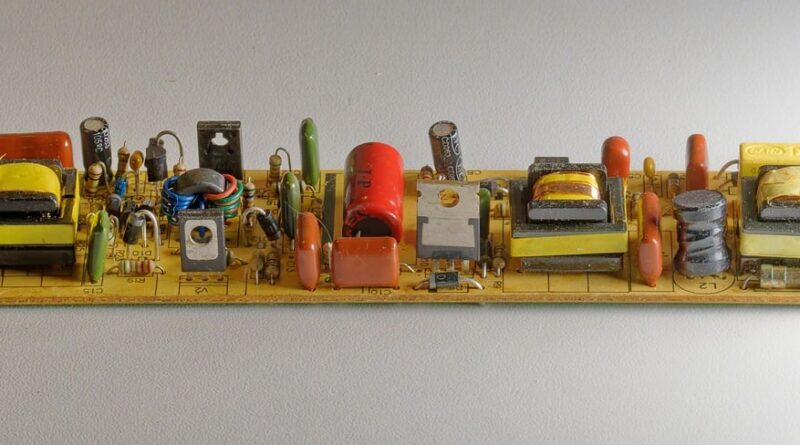
Discrete electronic components are individual circuit elements selected, placed, and qualified as separate parts, rather than functions embedded inside an integrated circuit. The term usually covers passive parts such as resistors, capacitors, inductors, ferrites, thermistors, varistors, and fuses, as well as discrete semiconductors such as diodes, rectifiers, transistors, MOSFETs, IGBTs, thyristors, Zener diodes, and TVS protection devices. They matter because board-level performance still depends on real component behavior: tolerance, temperature drift, leakage, parasitics, surge strength, thermal resistance, aging, and availability. For a broader component context, see our Components section.
In practice, readers usually want to answer three questions: what discrete parts are, how they differ from ICs, and what must be checked before using them in power, signal, protection, automotive, industrial, consumer, or communication products. A simple definition helps, but it is not enough. A 10 kΩ resistor, a 100 nF capacitor, or a 60 V MOSFET can behave very differently depending on package, material system, stress rating, and supplier documentation.
Discrete parts versus integrated circuits
An integrated circuit combines many active and passive functions on a chip or in a package. A discrete component performs one main function as a separately purchasable item. That difference is not only about size. It affects how a designer controls tolerances, dissipates heat, handles transients, verifies compliance, and manages second sources.
Discrete components often remain outside ICs for physical reasons, not just historical ones. Energy storage needs volume. Heat needs a path to copper, air, chassis, or a heatsink. Surge protection needs silicon area, ceramic mass, or dedicated construction. Precision sensing may require a known temperature coefficient. EMI filtering often depends on board placement and current-loop geometry. Even highly integrated power management ICs normally need external inductors, capacitors, feedback resistors, bootstrap parts, snubbers, and protection devices.
Integration can reduce bill-of-material count and assembly cost, but it can also reduce flexibility. Discrete parts let engineers tune a compensation network, adjust a cutoff frequency, change a divider ratio, increase creepage distance, select a better thermal package, or qualify a higher surge part without redesigning the whole IC section. In many products, the most reliable architecture is not maximum integration; it is the right split between IC functions and discrete components.
Main categories and what they control
Discrete components are easier to specify when they are grouped by circuit role, not just by catalog family. The same component value may be used for filtering, timing, damping, protection, sensing, biasing, or power conversion. The table below summarizes common categories and the parameters that usually drive design decisions.
| Category | Typical examples | Design checks that matter |
|---|---|---|
| Resistive parts | Chip resistors, current-sense resistors, networks, thermistors | Resistance tolerance, temperature coefficient, power rating, voltage rating, pulse capability, noise, long-term drift |
| Capacitive parts | MLCCs, film capacitors, aluminum electrolytics, tantalum capacitors, safety capacitors | Capacitance under bias, dielectric class, ESR, ripple current, rated voltage, lifetime, insulation resistance, safety approval |
| Magnetic parts | Inductors, ferrite beads, common-mode chokes, transformers | Saturation current, DCR, core loss, self-resonant frequency, impedance curve, temperature rise, shielding |
| Discrete semiconductors | Diodes, MOSFETs, BJTs, IGBTs, thyristors, TVS diodes | Voltage and current ratings, switching loss, leakage, capacitance, safe operating area, transient behavior, package thermal path |
| Protection parts | Fuses, PTCs, MOVs, TVS arrays, gas discharge tubes | Trip behavior, clamping voltage, surge waveform, capacitance, coordination with upstream protection, degradation after stress |
The printed value is only the starting point. A capacitor with the same nominal capacitance can lose effective capacitance under DC bias. A MOSFET with low on-resistance may have higher gate charge, which can increase switching losses at high frequency. A ferrite bead selected from its impedance at 100 MHz may heat excessively if significant DC current flows through it. Sound engineering selection therefore requires reading curves, not only headline ratings.
Why discrete components still shape product performance
Discrete electronic components turn theoretical circuit diagrams into manufacturable products. They set gain and thresholds, absorb transients, filter noise, store energy, divide voltage, sense current, switch loads, and protect connectors. Because they sit at the boundary between electrical design, layout, thermal design, compliance, and sourcing, small choices can have large system effects.
In power electronics, the external inductor, MOSFET, diode, current-sense resistor, and input/output capacitors often define efficiency, transient response, EMI behavior, and thermal margin. In high-speed interfaces, ESD diodes and common-mode chokes must protect the port without adding too much capacitance or mode conversion. In sensor interfaces, resistor tolerance and capacitor leakage can shift calibration. In battery-powered products, leakage current and capacitor dielectric behavior can determine standby life.
Market context also supports a careful approach. World Semiconductor Trade Statistics separated discrete semiconductors from other semiconductor categories in its 2026 outlook, with discrete semiconductors growing more moderately than the memory-led headline market. That does not make discretes unimportant. It means demand, pricing, and lead-time risk can differ from the AI accelerator or memory cycle that dominates many industry headlines. ECIA industry pulse reporting in 2026 also shows why component buyers track passives, electromechanical parts, analog ICs, and discretes separately rather than assuming one semiconductor trend explains the whole supply chain.
Selection checklist for engineers and buyers
A practical selection process should combine schematic requirements, physical constraints, reliability targets, and sourcing reality. The checks below help prevent a part from looking correct in a parametric search but failing in production.
- Electrical rating margin: Verify voltage, current, power, pulse, surge, and frequency conditions at worst-case temperature, tolerance, and line/load conditions.
- Derating method: Use a documented derating approach for capacitors, resistors, semiconductors, and magnetics. Derating should match the stress type, not just apply a generic percentage.
- Thermal path: Check package thermal resistance, copper area assumptions, airflow, adjacent heat sources, and enclosure temperature.
- Parameter curves: Review capacitance versus DC bias, MOSFET safe operating area, diode recovery, ferrite impedance versus frequency, inductor saturation, and resistor pulse curves.
- Layout sensitivity: Confirm loop area, creepage, clearance, current density, Kelvin connections for current sensing, and placement of protection devices near entry points.
- Second-source realism: A true alternative should match package, land pattern, rating, key curves, compliance status, and qualification level, not only nominal value.
- Lifecycle and change control: Review product change notification practices, end-of-life risk, authorized distribution availability, and whether the part has a stable industrial or automotive roadmap.
Buyers should not treat every substitution as a purchasing decision only. Replacing an MLCC dielectric, a TVS diode, a current-sense resistor, or a MOSFET package can require engineering review. In regulated, safety-critical, or automotive products, substitution may also require documentation updates, testing, or customer approval.
Compliance and qualification signals to verify
Component qualification is not the same as product approval, but it is a useful starting point. IEC 60384 is widely associated with fixed capacitors for electronic equipment, and IEC 60115 covers fixed resistors. These standards help structure ratings, test methods, and quality assessment concepts for the relevant component families. For automotive applications, the Automotive Electronics Council lists AEC-Q101 for discrete semiconductors and AEC-Q200 for passive components. These documents define stress-test qualification frameworks, but they do not remove the equipment maker’s responsibility to validate the part in its own application.
Environmental compliance is another layer. The EU RoHS framework restricts specified hazardous substances in electrical and electronic equipment, with compliance commonly evaluated at the material level rather than by the finished product mass alone. For a component engineer, certificates, material declarations, plating details, and exemption status can matter as much as the electrical rating. Where products are sold globally, teams may also need to track REACH declarations, conflict minerals reporting, halogen-free claims, and region-specific documentation requirements.
Safety-rated parts need particular attention. A capacitor used across the AC line or from line to protective earth is not interchangeable with a general-purpose capacitor of the same value and voltage. Safety capacitors, fuses, MOVs, thermal cutoffs, and isolation components must be selected according to the product standard, working voltage, impulse category, pollution degree, and failure mode expected in the end equipment. See also: Gadgets.
How to read a datasheet beyond the headline value
A datasheet is a risk-control document, not just a shopping page. For passive parts, start with construction, operating temperature range, rated voltage, dissipation factor, insulation resistance, aging, and endurance tests. For semiconductors, read absolute maximum ratings carefully, but design from recommended operating conditions, thermal curves, switching test conditions, and safe operating area. Absolute maximum ratings are not a normal operating target.
Pay close attention to test conditions. A MOSFET on-resistance may be specified at a particular gate voltage and junction temperature. A diode forward voltage may be stated at a pulsed current that does not represent continuous operation. An inductor saturation current may be defined by a percentage drop in inductance, while another supplier may define it by temperature rise. A capacitor lifetime claim may depend on rated temperature and ripple current. These details explain why two parts with similar parametric rows can perform differently on the bench.
Documentation quality is also a selection signal. Strong suppliers provide curves, land-pattern guidance, qualification summaries, PCN procedures, material declarations, and clear revision control. Weak documentation increases engineering uncertainty, even when the unit price looks attractive.
Practical examples by application
In a compact DC/DC converter, the obvious discrete components are the inductor, input capacitors, output capacitors, feedback resistors, and sometimes external MOSFETs or Schottky diodes. The hidden challenge is interaction. Lower ESR can improve ripple but affect loop stability. A smaller inductor can reduce size but increase ripple current and temperature rise. A MOSFET with lower conduction loss may increase switching loss if gate charge is high.
In an automotive sensor module, the bill of materials may include precision resistors, filtering capacitors, ESD protection, reverse-polarity protection, a transient suppressor, and an inductor or ferrite for conducted noise. In this setting, temperature range, vibration, qualification status, and long-term availability can matter more than a small cost difference. AEC qualification can support component screening, but the module designer still needs application validation.
In a USB or communication interface, protection devices must clamp ESD events while preserving signal integrity. A TVS diode array with high capacitance may protect the port but degrade high-speed signals. Placement also matters: a good protection device placed far from the connector can leave damaging current paths across the board.
Frequently asked questions
Are discrete electronic components only passive components?
No. Passive components are a major part of the discrete category, but discrete semiconductors such as diodes, transistors, MOSFETs, IGBTs, thyristors, and TVS diodes are also discrete components. The common feature is that they are selected as separate parts rather than integrated into a larger IC function.
Why use discrete components if ICs can integrate more functions?
Discrete parts provide flexibility, power handling, energy storage, thermal paths, surge capacity, precision value selection, and board-level tuning. ICs are effective for integration, control, and repeatability, but many real circuits still require external components to meet performance, safety, and reliability targets.
Can two components with the same value be interchangeable?
Sometimes, but not automatically. Interchangeability depends on package, tolerance, voltage rating, temperature behavior, parasitics, qualification, material compliance, lifecycle status, and application stress. For critical functions, engineering approval is safer than value-based substitution.
What is the biggest mistake when selecting discrete parts?
The most common mistake is relying on nominal values and maximum ratings while ignoring curves, test conditions, layout, thermal behavior, and sourcing constraints. A component that passes a spreadsheet filter may still be unsuitable once worst-case operation is reviewed.
How should a team balance cost and reliability?
Start by identifying which discrete components affect safety, compliance, thermal margin, calibration, or field failure risk. Spend engineering effort and qualification budget there first. For low-risk parts, cost optimization and approved alternates can be more aggressive, provided documentation and change control remain clear.